


I’m going to take you on a journey through the single biggest struggle I have recently started overcoming. This post is a vital part of my own path to acceptance and self liberation.
Looking in the mirror we often try to see what other people see when they look at us. For many years it has been a mildly distressing exercise for me to do. Many would think that thinness had spared me the agony of looking in the mirror and hating myself, but to tell the truth, it has only spared me the self-loathing experience of standing on a scale, and feeling deep disappointment and shame. For years I checked my belly to determine if it met the standards or not: despite not desiring a flat stomach, I often avoided public display of what I thought was a body too flawed to be seen. I acknowledge my own privilege here: I am white, blonde, and slim with fair eyes. I am pretty close in many ways to what is constantly fed to us as beautiful.
I truly believe that we have been collectively coached to feel unhappy when looking at our own image. We have also been taught to look for praises, especially if women.
Regardless of your age, body shape, gender, ancestry, state of health and occupation you have at times felt under pressure to “improve” the way you look. I did too. I was taught to look a certain way to be accepted, and that I would be penalized for not conforming. That is the story of my life!
If there is a part of me that has always been more prominent in my mind’s eye is my hair: health, beauty and sex appeal reside there. Despite the fact that people usually praise me for my grey-blue eyes, I never particularly liked my eyes.
My hair in retrospect was gorgeous when I was a child. I am not saying this because I would love to have it back, I am just saying that at that time it made sense to worship something beautiful, as I had been taught. Long, unruly, wavy, light brown, often frizzy and unmanageable: it was my personal representative then. I was in a good mood when it was clean and shiny, and when it was not, I could not feel good about myself and seldom avoided contact with people.
My body changed very early, and as a preteen I could barely recognize myself. Acne took over my face, my pores became a monstrosity I could not deal with rationally. Occasionally looking in the mirror made me cry out of despair and shame.
Hair, not the beloved wavy hair on my scalp, but the nasty kind, the wrong kind, according to society, enveloped my body, and so did self-loathing and shame. I can only describe what I felt then, staring at my image, as rage. It is at that point that I warned people not to take pictures of me, and once even erased my face using a black marker from pictures of a preteen party to rectify the mistake.
Up to this point it is all pretty normal, albeit worrisome.
Something else changed gradually, at a pace that made it almost undetectable for some time. My beloved hair seemed to dye itself, transitioning from brown to blond. Its texture and character changed over time: manageable, straight and soft to the touch. If all of this sounds good, it was, because it looked good too, back then. Little did I know about its causes, and what it meant for my future as a woman, in a society that is very strict about what is acceptable and what is not.
I will go straight to the point, at age 15, things got weird enough for me to check why I had such bad acne and fewer strands on my head. The answer was: androgenic alopecia.
The diagnosis was one meant to be fought, not accepted, for it is not acceptable for a woman to be androgynous and potentially bald. I could detail all the different medications I tried, but I won’t, because it is beside the point. I took hormones for many years in order to prevent my thinning and fine blonde hair from falling. Also, that was prescribed to prevent the growth of hair where it was not supposed to grow, and get rid of acne. My hair got better and worse, following cycles I could not make sense of, most of the time. I knew that summer was kinder to my hair, and that winter was best spent indoors, because fall claimed most of my hair. Depending on how my hair was doing, I socialized or avoided meeting new people, even avoided the ones I knew occasionally.
Starting during the “acne phase”, I grew more reserved and wary of people’s gaze, mentally pictured myself happy only if my flaws magically disappeared, and physically kept a distance from anyone who could look at my face or scalp up close. I knew it back then, I am fully aware of it now: this medical condition can isolate and distort one’s vision of reality, in ways unimaginable for someone who has never felt this level of disgust and rejection looking at the mirror.
For years little changed, I adjusted to keeping a little secret, making sure the effects of all the male hormones my body produced in excess were not visible. It worked for years, although I did not like looking at my own face in the mirror, I could tolerate it.
Some would credit this to maturing and growing out of the hateful thoughts of puberty, but I don’t. I know that the shift happened slowly, had to do with how I lived my life and the choices I made. In 2011 I moved to Vancouver, Canada.
Vancouver has changed the core of who I am, and my outlook on life and relationships. That is where I saw people living life freer from the constraints of the society we live in, something I had only glimpsed before. The queer, lesbian, gay, intersex, asexual, trans, polyamorous, gender-fluid, and feminist communities gave me a lesson on the possibilities available out there. The word here is: endless. There are endless possibilities, and no one can tell you what is right for you. This means you are in charge, a true citizen in your own body. This means you can stop listening to external voices, and focus on an internal one, much harder to hear.
It is one thing to say you can look the way you want, and feel powerful in your own skin, as an individual, and as part of a group and wider society. It is another to see it.
It is visually compelling and stimulating, so deeply influential that it takes time to sink in and bloom. It took me years to figure out what that freedom would look like in my body, and even longer to stand proudly as the person I am.
As I struggled with depression and anxiety, I kept looking at people who did not meet the standards like me, although openly, unlike me. They were not necessarily happy, satisfied and fulfilled, yet they had an aura of radiance and acceptance I could not fully take in and examine.
I moved to a place where I knew no one, again, for the second time in my life: Uruguay. There I met a man I dearly love, who inspired me to be myself, despite not accepting himself. His unconditional love wrecked havoc and turned my universe up side down, more than once. To him, I am more than my hair, and there is no question that what makes me attractive is the whole of me, not parts of me. He had no wish to correct my body, and my aversion towards it baffled him. I was the one who wanted to change and erase parts to the point of absurdity. By embracing me as an androgynous woman, he made me see my own body from a new perspective.
Waves of acceptance mixed with love, not just his, but my own, for my own flesh, changed the discourse, not just my feelings. On a rational level I could point at what was “wrong with me” and smile, knowing I could say “yes” intentionally, intensely, every single day to all the parts of me I misjudged and hid.
This is not to say I was done. No, I wasn’t. Time did not stand still after my shift in perception and attitude.
Despite all of this I felt under pressure and decided to try one last thing to change my fate. I underwent a procedure that was supposed to reactivate my follicles and give me some extra strands to show the world. It did not work, that is not to say it won’t if you try it. Despite the fact that it works for some, I’d like to discourage you from trying expensive treatments, mostly new, and sometimes untested on women in any clinical trials.
Last year one of the doctors’ prophecies came to life: I realized I was going bald.
My first thought was: “If it has to happen, not publicly, please.” I shaved my head, bought a wig I could afford, and dealt with everyone’s surprise when I wore it for the first time. Having to introduce myself, even when I knew people, or waiting for people to realize who I was, made me feel incredibly isolated again. Since I had moved to a different country by then, Ireland, I found myself lonely and not willing to socialize most of the time.
More than a year has passed, I am still in Dublin, and new waves of acceptance and love have engulfed me. I now wear a wig that reflects the bold person I want to be, after hiding and feeling small and helpless for over a decade. I now tell people that I am a balding woman when I trust them. I now share my story and allow people to tell me their stories. I now allow myself to walk in the park and feel the breeze. I now allow people to see me without a wig.
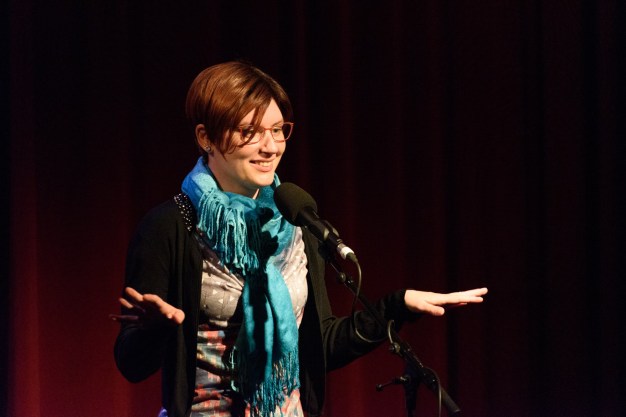
Credit: Dublin Story Slam, photo taken by Ian Mulholland.
The journey wouldn’t be complete if I only shared words. You need to see it.
I allowed Roger to take pictures of me. I, the person who couldn’t stand cameras and public attention, am sharing the story and letting my scalp breathe, so that everyone can see it.
I am a strong balding woman, with nothing to hide from the camera.
I am asking you to tell me how they make you feel, if you want to contribute with a comment. Don’t describe them (not even to praise), describe how this journey can inform yours, if that appeals to you.


Credit: photos taken by Roger Arruda
Daring to be bald means that going bald is not an obstacle, it is part of my identity. While I might not share this side of me with every person I meet, I do not think it is healthy for women to hide. Hiding and feeling shame keep us small and weak. Coming out of our dark corners and speaking up means that we can own our story, and feel empowered, as women and as human beings.
We are often told to be ashamed of ourselves as women, and as human beings speaking up in general. Daring to be bald means to me saying no to lotions and potions offered by the capitalist economy, being at peace with who I am, all of me, including my scalp and hair.
Daring to be bald also means that I am a woman, yes, though I define what that means to me. My body is t-shaped like the one of a man, looks like the one of a boy when I let go of all the things that make me look extra feminine, and I love it.
I like this strong and healthy body when I move, dance, sing, speak and stand on a stage to share my poetry. I choose the degree of femininity I need to look in the mirror and be at peace with what I see: a vibrant 30-year-old human being.
Daring to be bald, publicly and unapologetically, means saying “I am enough“.
And you are too. YOU are enough.
Let’s reclaim our power.
Love,
Dare to be b@ld
 Dare to be b@ld
Your story and these pictures are inspiring! I feel proud to know you when I read your story of struggle and self acceptance and see the photographs! The world needs so much more of this! As tumultuous as the world is, the essence of your story and photos is what gives me hope for our world and the future. Hope that we can all learn from your wisdom, learn to heal, and learn to love ourselves a little more everyday. I feel jubilant for you! Xo
LikeLike
Oww my teacher it was amazing, congrats ! You are absolutely beautiful!
LikeLike
There is so much beauty in your wisdom ❤
LikeLike